Our Heritage
Where
Civilizations
Cultivated
Excellence.
Long before olive oil became recognized as one of the world's finest culinary treasures, it shaped the economy, agriculture, and daily life of one of history's greatest civilizations.
That civilization was Carthage.
Founded on the Mediterranean coast of North Africa, Carthage grew from a thriving maritime settlement into a commercial power whose influence stretched across three continents. Its merchants connected distant cultures through trade, while its farmers transformed fertile landscapes into productive agricultural estates.
For the Carthaginians, olive oil was never simply another agricultural product. It represented prosperity, craftsmanship, health, diplomacy, and commerce. It illuminated homes, nourished families, accompanied religious ceremonies, supplied armies, and became one of the Mediterranean's most valuable trading commodities.
Today, although the empire itself has long disappeared, the olive trees remain. Many continue to flourish under the same Mediterranean sun that nourished generations before them.
The Timeline
Nearly three
millennia of heritage.
1200 B.C.
Carthage Founded
Carthaginian settlers establish Carthage on the Mediterranean coast of North Africa. Olive cultivation begins in earnest.
500 B.C.
Mediterranean Trade Dominance
Carthaginian merchant fleets carry olive oil amphorae across the Mediterranean, establishing commercial relationships throughout coastal Europe.
200 B.C.
Agricultural Mastery
Mago of Carthage writes the ancient world's most comprehensive agricultural treatise, encoding centuries of olive cultivation knowledge.
146 B.C.
Empire Falls, Groves Endure
Rome destroys Carthage, but the olive groves remain, continuing to flourish under the same Mediterranean sun for millennia to come.
1928 A.D.
Family Estate Founded
Our production partner establishes their family estate in Tunisia — beginning nearly a century of continuous olive oil production.
Today
Carthagene Olivos
Headquartered in California, we bridge ancient Mediterranean heritage with modern global distribution — 30+ gold medals and counting.
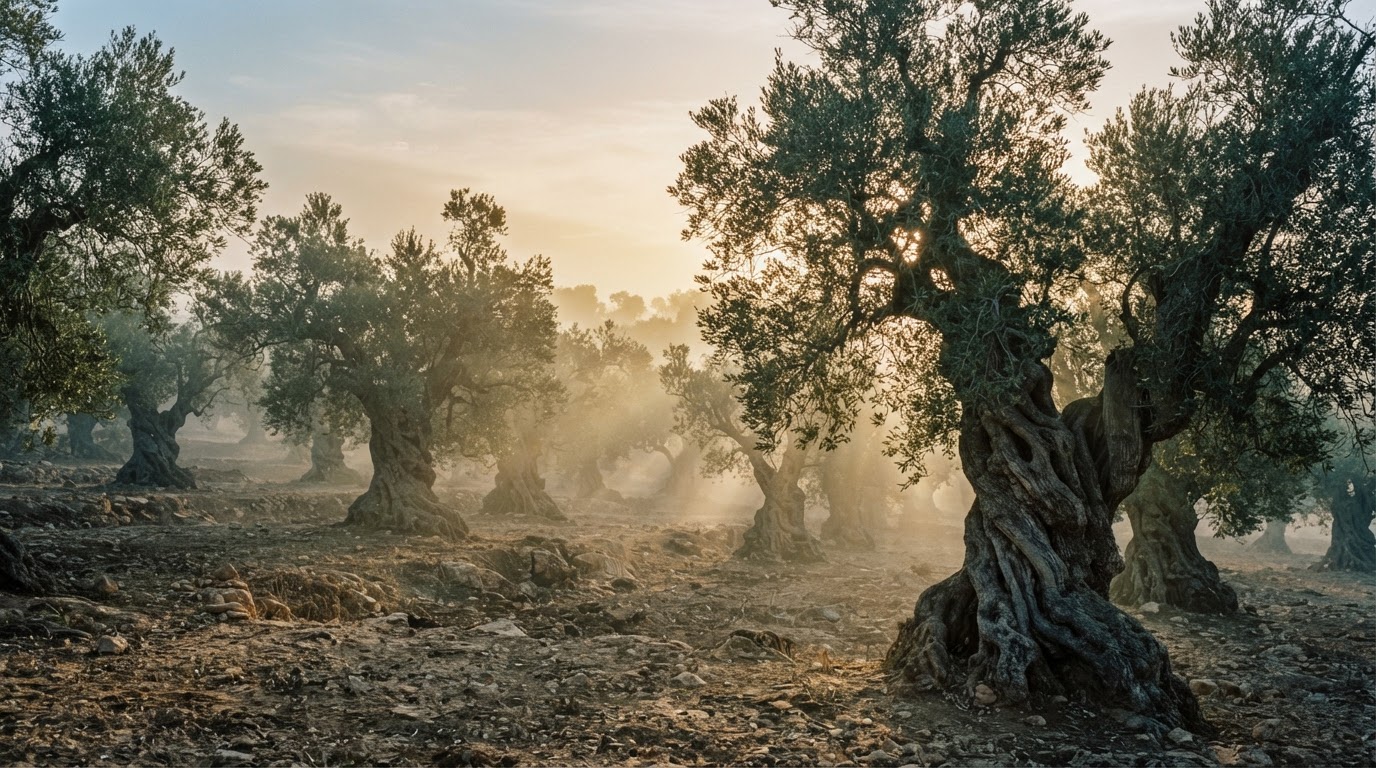
Tunisia: The Original Mediterranean Olive Landscape
An extraordinary
environment.
01
Warm Mediterranean Summers
02
Mild Winters
03
Mineral-Rich Soils
04
Coastal Breezes
05
Limited Rainfall
06
Hundreds of Sunny Days
Together, these natural conditions create olives with remarkable concentration, balanced fruitiness, naturally occurring antioxidants, and exceptional aromatic complexity. For thousands of years, families have cultivated these landscapes, preserving agricultural knowledge through countless generations while continuously adapting to advances in cultivation and production.
Our Olive Varieties
Every variety has
its own personality.
Chemlali
Graceful · Balanced · Versatile
Graceful, balanced, and remarkably versatile. Chemlali olives produce oils with delicate almond notes, buttery texture, gentle fruitiness, and exceptional smoothness. Their refined profile makes them equally suitable for everyday cooking and elegant finishing applications.
Chetoui
Intense · Complex · Bold
Known for greater intensity, Chetoui produces oils celebrated for their vibrant green aromas, higher natural polyphenol content, pronounced peppery finish, and remarkable complexity. These oils are especially appreciated by professional chefs and olive oil enthusiasts seeking bold Mediterranean character.
Since 1928
Continuing a
Family Tradition.
Our production partner has cultivated olive groves in the historic Mediterranean region of Tunisia for almost a century. Established as a family-owned agricultural enterprise, the company has dedicated generations to producing exceptional olive oils that respect tradition while embracing innovation.
Quality always comes first.